


08. Unsupported Stance Phases with Visual Tracking

The following are the 3 different stance positions you will perform the visual tracking exercises in. Due to the natural asymmetry of the body it is recommended to initially perform on your left side. As you progress you may alternate between sides.
Position 1: Early Stance

- Place your left foot in front of your right so that they are 2-4 inches wide apart where your right toes are across from your left heel.
- Shift your weight forward so that ~80% of it is on your left leg
- Rotate your pelvis/hips a little to the left
- Sense your left hamstring, inner thigh and outer hip engage
Position 2: Midstance
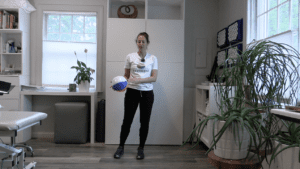
- Stand with your feet ~ 3-5 inches apart
- Exhale and gently perform a pelvic tilt by allowing your tailbone to come forward while keeping your knees unlocked but not bent deeply.
- Shift your weight over to your left so that ~80% of your weight is on your left leg. Your left hip should be directly over your left heel. Don’t overshoot so that your left hip is beyond your foot.
- Sense your left hamstring and inner thigh engage.
Position 3: Late Stance

- Place your left foot behind your right so that they are 2-4 inches wide apart where your left toes are across from your right heel.
- Shift your weight backwards so that ~80% of it is on your left leg
- Rotate your pelvis/hips a little to the left
- Sense your left hamstring, inner thigh and outer hip engage


- If you have any questions or need help with this exercise, join our Weekly Healing Q&A here.
- Join us for full access to the Resonate Health Master Guide
Support the Master Guide
If this Master Guide has supported you, please consider making a donation to help keep this free resource available.