
13. Pelvic Floor Breathing
This is a wonderful technique to help you restore and reclaim your pelvic floor function and foundational base!
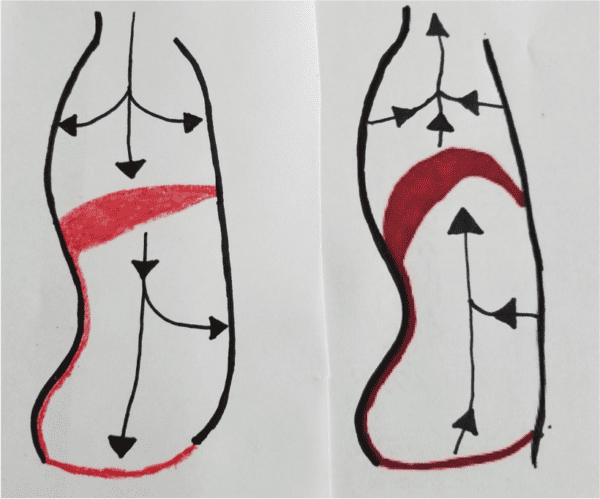
When you breathe, your respiratory and pelvic floor diaphragms need to work together to regulate the pressure in your abdominal and thoracic cavities. During inhalation both diaphragms lower/descend while during exhalation both diaphragms rise/ascend.
Many of us unknowingly have dysfunction with our diaphragm’s ability to appropriately rise and fall. This breathing technique will teach you how to appropriately activate and synchronize your diaphragms to promote not only optimal breathing but also posture, pelvic floor function and even lymphatic circulation.
This exercise invites down into the foundation of your body and is intended to reconnect you with your base and the root of your being. This is a powerful center and is known for safety, security and meeting your basic human needs.
Inhalation and Exhalation
Equipment needed:
- The lowest possible seat height you can comfortably sit in a squat position. The bottom step of the stairs typically works well.
Instructions:
- Position yourself in a squat position sitting on the lowest possible seat height, preferably the bottom step on your stairs. If this is not tolerable, move up a step or use some other low seat.
- Place your legs together. You may wrap your arms around your legs.
- 1st Breath Cycle Focus: Full exhalation sensing abdominals draw in
- Inhale softly, slowly and fully through your nose, while keeping your shoulders, neck and head relaxed.
- Purse your lips to slowly and completely let every last drop of air out of your lungs.
- Pause until you feel a mild urge to breathe again.
- 2nd Breath Cycle Focus: Sense mid back expansion on inhale
- Take another breath in by inhaling softly, slowly and fully through your nose. Sense the area between your shoulder blades expand.
- Purse your lips together as exhale sense your front lower ribs folding into your belly and your abdominals drawing in as you blow all the air out of you.
- Pause after you fully exhale, until you feel a mild urge to breathe again.
- Remainder of Breath Cycles Focus: Sense pelvic floor draw up/elevate on exhale
- Inhale again focusing on expanding the area in your mid back between your shoulder blades.
- This time as you exhale through pursed lips, focus your attention on your pelvic floor and try to sense it rising, drawing up into your body.
- Pause after you fully exhale until you feel a mild urge to breathe again.
- If you are unable to sense your pelvic floor lift as you exhale imagine that you are stopping the flow of urine to help engage your pelvic floor muscles.
- Important: Do not clench your buttocks together while attempting this.
- Repeat this breathing again. Inhale through your nose softly, slowly and fully sensing your mid back open. Exhale through pursed lips sensing your pelvic floor lifting up into your body while your abdominals draw in.
- Repeat this for a total of 5 breath cycles. Rest for ~1 min and repeat for a total of 3 sets.
- If you have significant pelvic floor weakness, you may not be able to do 5 full cycles and start to lose sense of your pelvic lift before the 5 cycles have completed. This will improve as you build up more endurance in this area.
Perform 2-4x a day, for the next 3-4 days and then as often as desired. *Unless otherwise directed.
- Optionally, use your testing technique to determine your optimal frequency and duration to perform.
- As you perform this technique you may want to breathe some type of positive resource into this area.
If you are unable to sense your pelvic floor lifting it is advised to perform the Supine 90/120 Hip Lift technique while attempting the pelvic floor lift.
If you have significant pelvic floor issues, it is recommended to perform the Foundational Pelvis Protocol incorporating the pelvic lift during exhalation for all the techniques.
Goal: Be able to feel the following with your neck relaxed:
- Your mid back (between your shoulder blades) expand during inhalation.
- Your pelvic floor lift/ascend during exhale
- Abdominals engaging and drawing in during exhalation
Enjoy these other related Master Guide items to resonate health:
Disclaimer and Copyright
This content is being provided for informational purposes only and is not a substitute for medical advice. This content has the potential to produce healing and detox responses. Please consult your medical doctor or professional if you have medical concerns. If you experience any discomfort or adverse effects discontinue.
©️ 2022 Resonate Health. This content may not be duplicated, copied or shared unless authorized.

CONTACT US
PRIVACY POLICY
TERMS OF SERVICE
CONDITIONS AND CONSIDERATIONS INFORMATION
© Resonate Health 2026 Original design by Abracadabra Creative | Ongoing development by Christian McFarland