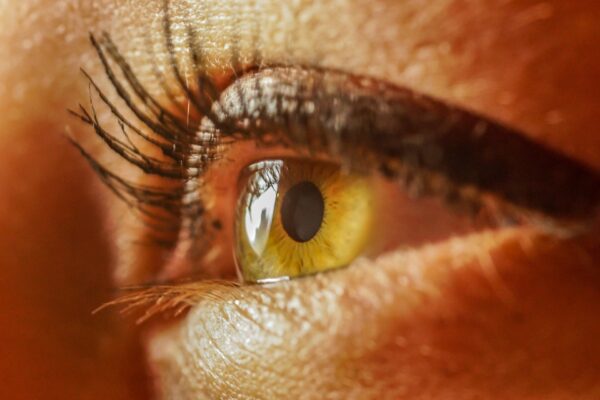
01. Vision-Postural Connection

Your vision has a big impact on your cranial bone, jaw and neck alignment which then affects your entire postural alignment below. Did you know that about 80% of the function of your visual system is to determine where you are located relative to the ground and space around you while only 20% is used for focusing on objects? However, in modern society we primarily use the focusing part of our visual system as we constantly lock into screens while our peripheral visual system doesn't get much of a work-out. Unfortunately, this type of chronic visual functioning creates stress in our postural system as it has only been a short time in our evolutionary history where we have made the transition from primarily using our ambient distant vision as we hunted and gathered vs the close-up screen use today. 

To determine if your visual pattern is contributing to tension in your body consider the following:

  • Do you have an asymmetrical prescription? It is common for us to not have the same prescription in the left vs right eye. Most of the time, the left eye is the more nearsighted eye and primarily used for focusing while the right eye has a preference for peripheral vision. 
  • Were you ever diagnosed with amblyopia (lazy eye) or stabisumus (crossed eyes)? If so, you likely still have asymmetrical visual patterning that is impacting the rest of your body.
  • Do you tend to trip or bump into objects? This indicates challenges with your postural-visual system accurately knowing where you are in space.
  • Do you have a strong prescription? Stronger prescriptions tend to be associated with increased head and neck tension, particularly if someone is over-prescribed with too much power. Many times Optometrists are primarily focused on how clearly you can see and tend to add too much power in your lenses. Ideally, you would have the least amount of power to be able to clearly see.


How to Determine if your current visual pattern is contributing to postural tension: 

  1. Perform the Physical Resonance Tests for your neck to determine your baseline flexibility and mobility.
  2. You will now perform any of the following and then re-check your neck range of motion to determine if there is a positive, negative or no change.
    1. Left Peripheral Vision or Reduce Right Peripheral Vision
    2. Place +.25 over-the-counter reading/computer glasses, like these, over your current distance prescription. This could be over your contact or current glasses.
    3. With the +.25 over-the-counter glasses over what you normally use to read (which might be another pair of glasses, contacts or nothing at all), read your computer and/or phone screen for 1 minute and then re-check your neck range of motion.
      • If your neck range of motion improved or became more comfortable, you likely would benefit from some additional magnification.
      • If you are under the age of 40 you likely just need +.25 power.
      • Between the age of 40-50, usually a power of +.50 - +100 is needed which will continue to increase as your get older.
      • Consult with an optometrist with special behavioral or neurological training (or a regular optometrist if a specialist is not accessible to you) to determine which is best for you. You may also need some other lens features such an astigmatism that will require a prescription in order to obtain.