


07. Standing Supported Glute Max
This PRI inspired technique will teach you how to appropriately shift from one hip to the other, an essential element of optimized walking and running mechanics.
Due to the asymmetrical nature of the human body, we tend to be more shifted into the right hip and pelvis. This technique respects this tendency where you will focus more on shifting off the right hip to be able to transition onto the left side.
Training these neuromuscular patterns will also help to optimize your postural alignment and control. Notice the improved sense of motion and freedom in your gait afterwards.
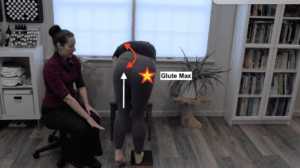
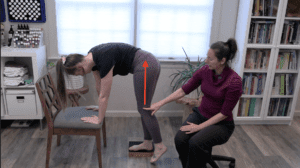
Equipment Needed:
- Sturdy chair.
- 1-2 inch block or book.
Instructions:
- Stand with your arms supported on the base of the chair.
- Place your right foot on the left side of a 1-2 inch block or book, keeping most of the weight through your left leg.
- Press your palms into the chair rounding out your back.
- Sidebend your trunk to the left by dropping your left shoulder 1-2 inches so that your left ribs and pelvis are “scrunched” or closer together than the right side.
- Softly, slowly and fully inhale through your nose keeping your neck and shoulders relaxed as you maintain a push/elongation with your arms into the chair. Sense the area between your shoulder blades expand.
- Purse or pucker your lips as you slowly and fully exhale all of the air out of your lungs sensing your abdominals draw in and engage.
- Without shifting or leaning to the right, raise your left leg directly upwards like an elevator as you press your right foot into the block/book.
- You should sense your right glute max engage and more weight through the inner part of your right foot/arch region.
- While maintaining this position, softly, slowly and fully inhale through your nose keeping your neck and shoulders relaxed. Sense the area between your shoulder blades expand.
- Purse or pucker your lips and slowly and fully exhale all of the air out of your lungs sensing your abdominals draw in and engage.
- Pause until you feel a mild urge to breathe again.
- Perform 5 breath cycles.
- Switch to the other side so that you are standing through your left leg and perform 5 breath cycles.
- Return to standing on the right leg for another 5 breath cycles.
- Complete 2-3 sets of 5 breath cycles, on each leg, but always start and finish grounding on the right leg. (ie. 2 sets on the right/1 set on the left, or 3 sets on the right/2 sets on the left.)
- Perform 2-3x/day, for the next 3-5 days. *Unless otherwise directed
- Optionally, use your testing technique to determine your optimal frequency and duration to perform.
Support the Master Guide
If this Master Guide has supported you, please consider making a donation to help keep this free resource available.