


07. Neutralizing Cravings and Addictive Behaviors

When you experience cravings or addictive behaviors, it is encoded in your brain and nervous system as a multi-sensory emotional pattern which can include the felt sense of your body (somatosensation), along with visual, taste and smell associations. Because these patterns are stored through multiple sensory channels, neutralizing them in your nervous system is often most effective when using multi-sensory techniques.
Cravings and addictive behaviors can be tied to physical, emotional, mental and spiritual factors which are discussed in more detail here.
The following technique will focus on the somatoemotional elements and draws strongly from Cognomovement but with additional layers using sound and specific postural and breathing techniques to amplify your multi-sensory reprocessing experience.
*Caution: If you are performing this technique to alleviate a particular addiction which involves chemical dependency, it is recommended to perform in conjunction with your healthcare provider as you may experience physical withdrawal symptoms as your use of the chemical decreases.
Neutralizing Cravings Outline
- Establish Your Baseline
- Identify the: Craving or addictive behavior along with any accompanying sensations and its intensity.
- Practice the Breathing Method
- Gently inhale through nose, fully exhale with pursed lips, pause 3 seconds.
- Find Your Frequencies
- Use the Free Resonate Health Harmonic Resonance app to play different frequency tones and select the ones that feel the best.
- Adjust the tones playing until you find the combination that leaves you feeling more relaxed in your body. This will be your frequency bundle that you use in this protocol.
- Perform the Integrative Techniques
- Think about how much you enjoy your craving/addictive behavior while you perform these integrative techniques and breathe.
- Re-check Baseline
- Take note in your private Resonate Health journal.
- Reference a New Choice
- Create a journal entry that includes a description of your new choice
- Imagine yourself embodying this new behavior
IMPORTANT INFO - READ BEFORE YOU START
Safety, Healing and Detox Information
- This protocol intentionally brings up your craving or addiction to support healthy processing and transformation of it.
- If you have a physical dependency on the food, beverage or substance, please ensure you have appropriate support to transition you off the physical dependency of it. This might involve getting additional professional support.
- If this protocol becomes too much or overwhelming for you and you are safe, use this tuning to quickly calm any intense uncomfortable sensations.
- You always have access to this Safety, Healing and Detox Support.
- Reference the information and resources as needed- at anytime.
- If you notice you are unable to regulate yourself or are overwhelmed with the process, consider a 1:1 session for individual guidance and support.
Optional Positioning and Parameters for Sensitive Individuals
- If you are unable to tolerate this protocol standing, it is suggested to try sitting.
- If you are unable to tolerate sitting, you may perform it laying on your back with your knees bent.
- You may even place your legs up on a chair, ottoman or stacked cushions to reduce pressure through your low back.
- It is suggested to support the natural curvature of your neck with a towel roll or pillow.
- Sometimes you may be able perform some of the techniques standing or sitting and others laying down.
- Sometimes you might not able to perform all of them.
- If you have trouble tolerating the visual tracking you can:
- Go slower
- Reduce the amount you are moving (less side to side or up and down)
- Pause at certain areas while looking at the ball in a stationary position.
- Take breaks.
- If you cannot move the ball due to arm limitations, you can move your eyes in the patterns without handling and tracking the ball.
- Whatever you can do is perfectly fine and simply do the best you can.
- You may need to gradually work up your tolerance.
INTRODUCTION
Watch this first
- This protocol intentionally brings up your craving or addiction to support healthy processing and transformation of it.
- If you have a physical dependency on the food, beverage or substance, please ensure you have appropriate support to transition you off the physical dependency of it. This might involve getting additional professional support.
- If this protocol becomes too much or overwhelming for you and you are safe, use this tuning to quickly calm any intense uncomfortable sensations.
- You always have access to this Safety, Healing and Detox Support.
- Reference the information and resources as needed- at anytime.
- If you notice you are unable to regulate yourself or are overwhelmed with the process, consider a 1:1 session for individual guidance and support.
Before beginning, it is essential to identify craving or addictive behavior you specifically want to address. You likely have multiple issues going on but it is best to choose one at a time and work on them sequentially.
STEP 1: Establish Your Baseline
GUIDANCE TO ESTABLISH YOUR BASELINE
Follow these steps to identify your current craving and intensity
Step 1: Identify the Craving or Addictive Behavior
Choose the primary craving/addictive behavior you want to address. If multiple ones are present, focus on the one that feels most dominant right now. This could be any of the following:
- A food, beverage or substance
- A relationship where you feel obsessed about the person or codependency
- An activity (gambling, exercise, sex, shopping, video games)
- Internet, social media
- Drama in your life
- Negative self-talk
Step 2: Prepare
- If the craving is an actual food, beverage or substance that you can safely use you will physically ingest it while performing the techniques. Go ahead and procure it.
- If the craving is an activity that you can perform intermittently during the techniques prepare to do it. An example would be to intermittently play a video game.
- If the craving does not allow for you to actively partake in it that is fine. You will simulate it within your mind, heart and body instead.
Step 3: Bring it up.
Allow yourself to experience your craving (if possible and safe to do so). You will either actually partake in it or imagine yourself doing it. You want to REALLY savor and enjoy it. Allow yourself to be fully immersed in the experience of it. Notice how it makes you feel:
- Physically
- Emotionally
- Mentally
Step 4: Rate the Intensity
Rate the intensity of your craving on a scale of 0–10:
- 0 = no issue
- 10 = maximum intensity
It is suggested to write this information down in your journal along with any other insights that come to you.
This is your baseline.
You have now identified your craving or addictive behavior including how you experience it in your body and how intense it is.
This is your baseline and you will reflect back on this starting point at the end of this technique.
Before moving on, it is highly recommended to write this information down in your journal along with any other details that come to you. (Your Resonate Health Journal is private and is a great place to reflect.)
Next, you will review and practice the breathing method to be used throughout this protocol.
STEP 2: Practice Breathing Method
Breathing supports the healthy processing and integration of your craving/addictive behavior and it is important to continue to breathe to process the energy.
Practice the breathing method described below now.
Breathing Method
We recommend the following breathing method:
- Inhale gently through your nose
- Pucker or purse your lips as you FULLY exhale all the air out of your lungs sensing your front lower ribs drop downwards into your belly and your abdominal wall draw in and engage. This will take about 4-8 seconds.
- Pause ~3 seconds after each exhale.
Perform a set of 3-5 breath cycles right now.
The only technique where you won't be focused on breathing is when you are naming the color on the horizontal tracking technique.
You have now reviewed and practiced the breathing method you will use during the techniques.
STEP 3: Find Your Frequencies
Sound is tremendously powerful at helping your nervous system rewire patterns. It is now time to open the Resonate Health Harmonic Resonance App.
The goal of this step is to find a bundle of frequencies that leave you feeling more relaxed in your body.
Follow the guidance below to find frequencies that feel calming to you.
Guidance to Find Your Frequency Bundle
Open the Resonate Health Harmonic Resonance App here
- This free app plays harmonics of frequencies structured in the golden ratio. We credit Banah Winn with discovering the healing impact of listening to frequencies structured in the golden ratio.
- The default setting is GOLDEN – 174 Hz.
- Use the Harmonic Resonance App – Adjusting Frequencies Demonstration Video below to learn how to use the app.
1. Body Check-In
Before listening to any tone bundle, notice how you feel in your body. The goal is to find the frequency bundle that helps you feel more relaxed.
2. Begin with the Default Frequency Bundle
Press Begin to play the GOLDEN – 174 Hz default frequency bundle.
Check in with your body and record your response in your journal:
- ✓ = I feel more relaxed
- X = I feel more tense or less comfortable
- – = I notice no difference
3. Adjust the Frequencies if Needed
If the default bundle makes you feel more tense, less comfortable or no difference, adjust the frequencies in the order below, checking your body’s response after each change.
Continue adjusting until you find the combination that leaves you feeling more relaxed in your body. If you are unable to find one that makes you feel more relaxed then go with the one that is neutral and doesn't make a difference. This becomes your frequency bundle for the protocol.
Use the Harmonic Resonance App – Adjusting Frequencies Demonstration Video below for guidance.
GOLDEN – 174 Hz
- Unhighlight 456 Hz and reassess (✓, X or –).
- Unhighlight 282 Hz and reassess (✓, X or –).
SCHUMANN
- Switch from GOLDEN to SCHUMANN and reassess (✓, X or –).
- Unhighlight 1002 Hz and reassess (✓, X or –).
- Unhighlight 501 Hz and reassess (✓, X or –).
- Unhighlight 251 Hz and reassess (✓, X or –).
4. If You Still Feel Tense
Use SCHUMANN with only 62.6 Hz and 125 Hz highlighted.
Harmonic Resonance App - Adjusting Frequencies Demonstration Video
Use Your Frequency Bundle Throughout the Protocol
Once you have established your frequency bundle, keep the tones playing continuously throughout the protocol.
- Standing or sitting: Place the device behind you, centered as closely as possible with the midline of your body. If that is not possible, place it in front of you, centered with your body’s midline.
- Lying down: Place the device above your head.
Optional - Bonus Vocal Toning Technique
For an enhanced effect, you may consider vocally toning one of the frequencies playing in your Harmonic Resonance bundle.
This can be challenging as there is more than one frequency being played simultaneously. Choose the one that you can best synchronize with and vocally tone it during your exhale.
You have now set up your device, playing your specific frequency bundle, in a comfortable location.
Keep the frequencies playing continuously and move on to the next step .
You may change the frequencies and tone playing at anytime to ensure it is grounding and centering for you. Your frequency bundle can change so adjust the tone as needed.
STEP 4: Perform Integration Techniques
Perform the following techniques in the order listed below while you allow yourself to experience your craving or addictive behavior (either for real or imagining it), relishing in how much you enjoy it, periodically during the techniques.
Focus on all the different aspects of your enjoyment. This could involve taste, smell, sounds, sights, sensations, a rush of excitement, safety, comfort, etc.
You will check in on the intensity of your craving/addictive behavior between each technique.
1. Bias Your Left Side
While performing the following techniques, it is best to do them in standing. However, if you cannot tolerate standing, then sitting or even laying on your back with your knees bent can work just as well. Regardless of the position, try to have more weight on your left vs your right side. If your left side gets tired you can always come back to the center.
- When done in standing, shift your weight to the left so that your left hip is directly over your left heel/ankle. Do not overshoot so that your left hip is beyond your left heel/ankle. Appreciate the increased sensation of weight going through your left leg.
- When done in sitting, shift your weight to the left so that you sense more weight through your left sit bone. Appreciate the increased sensation of weight being experienced here.
- When done laying down with your knees bent, head/neck supported with a pillow or towel roll, gently press your left heel down into the floor as you perform a pelvic tilt. Your tailbone will raise off the floor and low back flatten into the ground. You will sense engagement of your left hamstring.
2. Low to High Horizontal Visual Tracking
Allow yourself to feel the enjoyment of your choosen food/beverage/substance/activity or even relationship you are intending to neutralize while performing the following technique. Play your frequency pattern throughout.
- Hold the rainbow ball at belly level so your eyes look as far downward as they can without moving your head.
- Track the ball side to side with only your eyes only, keeping your head still.
- At each end range, say aloud the dominant color you see.
- As you move the ball side to side, rotate it to shift visible colors.
- After each pass through, raise the ball about 1 inch higher and complete another side to side cycle at the higher level.
- Continue progressing upward step-by-step until the ball is above your head and your eyes are looking upward as far as possible without head movement.
- Once at the top, fully exhale as you slowly return the ball to your belly.
*If standing or sitting is too challenging for you, perform this laying down. You may also need to take breaks, perform for shorter durations, go slower and/or reduce the amount you are moving the ball side to side and/or upward.
3. Alternating Hemi-Circles Visual Tracking
Continue to experience your craving (either for real or imagining it) and relish in how much you enjoy it.
Focus on all the different aspects of your enjoyment. This could involve taste, smell, a rush of excitement, safety, comfort, etc.
Listen to your Harmonic Resonance tones while performing diaphragmatic breathing.
- Maintain your left bias as best you can.
- Hold the ball at your lower abdomen with both hands.
- Using your eyes only, trace the following hemi-circle pattern with the ball:
- Upward through midline
- Out to the side with one hand (same side/same hand), creating a hemi-circle.
- Back through center
- Switch hands at chest level and move upward through the midline.
- Out to the other side with one hand (same side/same hand), creating a hemi-circle.
- Keep your head still throughout.
- Make the pattern large enough to challenge eye tracking without losing control or head stability.
- Move slowly and deliberately to avoid skipping or losing the target.
Notice if you have difficulty in any region. If so:
- Hold the ball in the specific areas you feel strain or challenge as you continue to breathe and/or tone.
- Slow down
- Make your pattern smaller
*If standing or sitting is too challenging for you, perform this laying down. You may also need to take breaks, perform for shorter durations, go slower and/or reduce the amount you are moving the ball side to side and/or upward.
4. Asymmetrical Figure 8 Walking
Continue to experience your craving (either for real or imagining it) and relish in how much you enjoy it.
Focus on all the different aspects of your enjoyment. This could involve taste, smell, a rush of excitement, safety, comfort, etc.
Continue to breathe and listen to your frequency pattern.
- Walk in a figure 8 pattern where the clockwise circle is smaller than the counterclockwise circle.
- Perform 8-10 cycles looking out on the horizon. If you don't feel secure looking out on the horizon, you may look down.
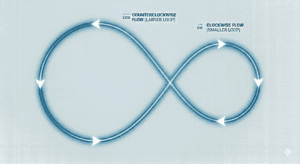
*If you are unable to tolerate asymmetrical figure 8 walking, it is suggested to try imaging yourself doing so.
5. Cross Body Tapping
Continue to experience your craving (either for real or imagining it) and relish in how much you enjoy it.
Focus on all the different aspects of your enjoyment. This could involve taste, smell, a rush of excitement, safety, comfort, etc.
Breathe and listen to your frequency pattern.
Whatever side of the body is being tapped, the opposite sided hand is doing the tapping. Example: Tapping left arm, torso or leg with the right hand.
Part 1: Front Back Upper Body:
- Raise one arm out in front of you, shoulder level, palm down
- Tap along your arm in the following sequence:
- Your upper chest (near collarbone) with your opposite hand
- Down along the top part of your upper arm, lower arm to your fingertips
- Fingertips to your armpit along the underside of your arm
- Armpit returning to the upper chest
- Then switch hands as you cross to the opposite side repeating the sequence
- Repeat this 3x each side
Part 2: Front Side Trunk
- Tap around your trunk in the following sequence:
- Front center lower abdomen
- Upwards through your solar plexus to the top of your sternum.
- Across your body to the opposite side of your tapping hand
- Down along the side of your trunk
- Returning to your lower abdomen and switching hands at midline
- Repeat on the other side.
- Repeat 3x each side.
Part 3: Front Back Lower Body
- Tap along your leg in the following sequence:
- Front lower abdomen with your opposite hand
- Front thigh to lower leg to top of foot
- Bottom of foot (skip if have shoes on) to back of heel
- Back of leg and pelvis switching arms as you cross to the other side repeating the sequence.
- Repeat this 3x each side
* If you are unable to tolerate this activity standing or sitting, you may perform it laying down.
6. Venting It Out Ear Rub
Continue to experience your craving (either for real or imagining it) and relish in how much you enjoy it.
Focus on all the different aspects of your enjoyment. This could involve taste, smell, a rush of excitement, safety, comfort, etc.
Continue to play your frequency pattern throughout this technique.
Set a timer for 60 seconds while you perform the following:
- Cross your arms over one another and grasp your right ear at the attachment of your right upper outer lobe with your left thumb/index finger and your left ear at the attachment of your left upper lobe with your right thumb/index finger.
- Make circles with your fingers rubbing your outer ear lobe top to bottom while venting about your issue. Then repeat the same pattern on your inner ear lobe from the top to the bottom.
- Let yourself really express how problematic, painful and/or stressful it is how it makes you feel.
- Finish with a forward ear pull.
*If you are unable to tolerate this activity standing or sitting, you may perform it laying down.
7. Hemi Up and Down Visual Tracking
Continue to experience your craving (either for real or imagining it) and relish in how much you enjoy it.
Focus on all the different aspects of your enjoyment. This could involve taste, smell, a rush of excitement, safety, comfort, etc.
Continue to play your frequency pattern and breathe throughout this technique.
- Shift your weight to your left leg and try to maintain more weight through your left heel throughout the technique.
- Starting with the left side and keeping your head straight, move the ball up and down tracking it with your eyes only.
- Perform ~10 times,
- Switch to the right side.
- Finish with another 10 cycles on the left side.
*If you are unable to tolerate this activity standing or sitting, you may perform it laying down. As needed, you may go slower, reduce the amplitude of your movement or repetitions.
8. Side Stepping with Rotation
Continue to experience your craving (either for real or imagining it) and relish in how much you enjoy it.
Focus on all the different aspects of your enjoyment. This could involve taste, smell, a rush of excitement, safety, comfort, etc.
Breathe and listen to your frequency pattern.
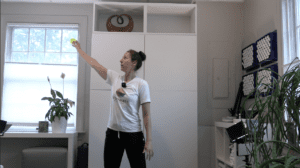
- Step to the side and slightly backwards as you raise the same-side arm upward and outward while holding the ball. Allow your trunk to rotate naturally toward that side.
- Track the ball with your eyes as your arm moves in a circular pattern back towards the center as you step back to the center.
- Pass the ball to the opposite hand and repeat the movement on the other side.
- Continue moving in a smooth infinity (∞) pattern while tracking the ball with your eyes and maintaining your breathing pattern.
- Perform 8 cycles on each side.
*If you are unable to perform this standing you can try sitting while you just move your arms and torso. If you cannot tolerate that, you can imagine yourself doing it.
STEP 5: Re-check Your Baseline
After completing the last integration technique it is time to tune back into your craving/addictive behavior.
Use the following guidance to re-check and determine your next steps.
Guidance to re-check your baseline
- Consider your craving or addictive behavior
- Do you still feel the same intensity?
- Rate it on a 0-10.
- If it is a 0 then you are all done processing it and may choose to repeat this process with any other cravings or addictive behaviors.
- If it >0 then it is recommended to continue to repeat this process until it is a 0. Typically, multiple rounds are required.
Ensure You Acknowledge All Aspects of Your Craving/Addictive Behavior
In addition to the smell, taste, sensation, visual and auditory aspects of your craving/addictive behavior, ensure you are also acknowledging any rush or high it might be providing you. After you have finished neutralizing the craving, you may spend some time reflecting on any reasons or motivations behind why you may have held onto your craving/addictive behavior. Consider writing any insights in your journal.
STEP 6: Reference a New Choice
Congratulations!
It is now time to establish a new empowering choice that supports you!
It is recommended to listen to your Harmonic Resonance frequency bundle and breathe as you perform this final step.
Guidance for Referencing a New Choice
- Consider if instead of your craving or addictive behavior, you could make an alternative choice.
- Examples:
- A healthier food or beverage
- Meditating
- A well balanced exercise regimen
- Spending more quality time with your family and friends
- A balanced and nourishing relationship
- Getting out into nature more
- Whatever, comes to mind
- Once you have identified your desired choice, imagine yourself embodying it.
- Set a timer so you may perform this for 5 minutes.
- Record any insights in your journal.
- Take note of any detail: physical (sensations), heart (neutral or positive emotional states), mind (positive word, statement or new belief), soul (coherent aligned embodied sense of Self and true purpose).
Goals:
-
- Keep the head straight and still with neck/shoulders relaxed while performing the visual tracking techniques
- Perform eye tracking without strain, skipping or nystagmus
- If performing toning, stay in tune with each frequency
- Reduce your craving or addictive behavior intensity to 0/10
- Be able to reference an alternative choice that supports your well-being

- If you have any questions or need help with this exercise, join our Weekly Healing Q&A here.
- Join us for full access to the Resonate Health Master Guide
Enjoy these other related Master Guide items to resonate health:
Disclaimer and Copyright
This physical exercise recommendation is being provided for informational purposes only and is not a substitute for medical advice.
Please consult your medical doctor or professional if you have medical concerns. If you experience any discomfort or pain, discontinue the exercise.
Technique inspired by Cognomovement and the Standing Wall Supported techniques by the Postural Restoration Institute®. www.posturalrestoration.com
©️ 2026 Resonate Health. This video may not be duplicated, copied or shared unless authorized.
Support the Master Guide
If this Master Guide has supported you, please consider making a donation to help keep this free resource available.

CONTACT US
PRIVACY POLICY
TERMS OF SERVICE
CONDITIONS AND CONSIDERATIONS INFORMATION
© Resonate Health 2026 Available Offerings FAQ Shop Articles Case Studies Testimonials Original design by Abracadabra Creative | Ongoing development by Christian McFarland