


14. Multidimensional Truth Self-Reflection
Much of human tension arises not from events themselves, but from the belief that there is only one correct way to interpret them. When we hold tightly to a single version of truth, your perceptual system narrows, your body contracts and your capacity for resonating in alignment with who you really are diminishes. This rigidity can show up as stress, emotional charge, defensiveness or a sense of being right but not authentically at ease.
Yet truth is rarely singular. Most situations contain many layers of meaning, context and validity operating simultaneously. When you learn to sense beyond your first interpretation, your system naturally softens and reorganizes. Perspective expands. Choice returns. Coherence increases.
This self-reflection invites you to explore a situation you feel strongly about and consciously widen your field of perception. The goal is not to invalidate your experience or abandon discernment. Rather, it is to recognize that truth has many dimensions and that holding multiple aspects at once creates greater internal stability and clarity.
When you allow more than one truth to coexist, you move out of polarization and into a place of neutrality, where you can view truth through the many layers and lenses that are operating. This is not about agreement. It is about capacity.
What Strong Opinions Can Reveal
Strong opinions often signal areas where your system is highly invested. These moments are rich with information. They point to values, boundaries, past experiences and conditioned beliefs. By gently examining them without judgment, you transform reactivity into insight.
As you practice perceiving multiple truths within a single situation, your nervous system learns to tolerate complexity. This strengthens emotional regulation, improves relational coherence and supports wiser action. You begin responding from clarity rather than defending a position.
Over time, this practice helps dissolve the illusion that safety comes from certainty. Instead, safety emerges from flexibility, awareness and trust in your ability to meet reality as it is.
Why 12 Perspectives
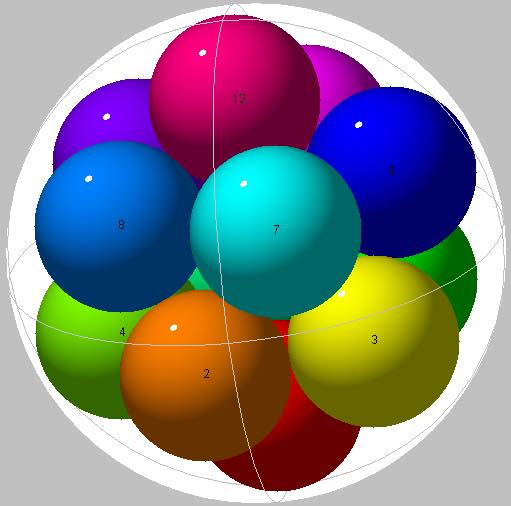
In sacred geometry, the number 12 represents wholeness through perspective. It takes 12 equally sized spheres to fully surround and cover a central sphere from every angle, meaning that no single viewpoint can capture the whole on its own. Only when all 12 perspectives are present does the central reality become fully known.
This principle mirrors perception. Any situation you are centered within cannot be truly understood from one angle alone. By intentionally identifying 12 different aspects of truth, you are not seeking perfection or intellectual completion. You are training your system to orient toward wholeness rather than fixation.
This practice restores balance by reminding your awareness that truth is relational, layered and dynamic.
Instructions
- Perform the Space Between Thoughts or Opening the Mind Meditation.
- Reflect on the prompts below for approximately 5–15 minutes per day for 3–5 days.
- Choose one situation at a time and stay with it rather than moving quickly through multiple examples.
- You do not need to resolve anything or take action. Remain curious and observational.
- Repeat this self-reflection in about 4 weeks to notice how your perception has shifted and to gather new information that supports coherence and discernment.
- Optionally, use your testing technique to determine your optimal frequency and duration for this reflection.
Multidimensional Truth Self-Reflection Prompts:
- Identify a situation, belief or conflict you currently have a strong opinion about. What feels certain or non-negotiable about your view?
- What emotions arise in your body when you think about this situation? Where do you feel them?
- Write down your current interpretation of the truth as clearly as possible.
- Now begin expanding perspective. Without negating your own experience, identify 12 different aspects of truth related to this situation. These may include:
- Another person’s perspective
- Context you may not fully see
- Structural, cultural or systemic influences
- Emotional truths versus factual truths
- Short-term truth versus long-term truth
- What may be true for one person but not another
- Which of these aspects feels most difficult to acknowledge? What happens in your body as you consider it?
- Are there any truths that can coexist even if they appear contradictory?
- How does holding multiple truths at once change your emotional charge or sense of certainty?
- What new information or understanding becomes available when you widen your perspective?
- How do you feel as your view expands? Does it create more space, neutrality or internal steadiness?
- How might this broader perception influence how you respond or act, without forcing change?
Closing Reflection
As you learn to perceive truth as multidimensional, your system becomes less reactive and more resilient. You do not lose clarity by expanding perspective. You gain depth.
When you can hold many truths without collapsing into confusion or rigidity, you move closer to coherence. From this place, discernment sharpens, compassion deepens and your responses align more naturally with your inherent resonance.

Enjoy these other related Master Guide items to Resonate Health:
Disclaimer and Copyright
This content is being provided for informational purposes only and is not a substitute for medical advice. This content has the potential to produce healing and detox responses. Please consult your medical doctor or professional if you have medical concerns. If you experience any discomfort or adverse effects discontinue.
©️ 2022 Resonate Health. This content may not be duplicated, copied or shared unless authorized.
Support the Master Guide
If this Master Guide has supported you, please consider making a donation to help keep this free resource available.

CONTACT US
PRIVACY POLICY
TERMS OF SERVICE
CONDITIONS AND CONSIDERATIONS INFORMATION
© Resonate Health 2026 Available Offerings FAQ Shop Articles Case Studies Testimonials Original design by Abracadabra Creative | Ongoing development by Christian McFarland