
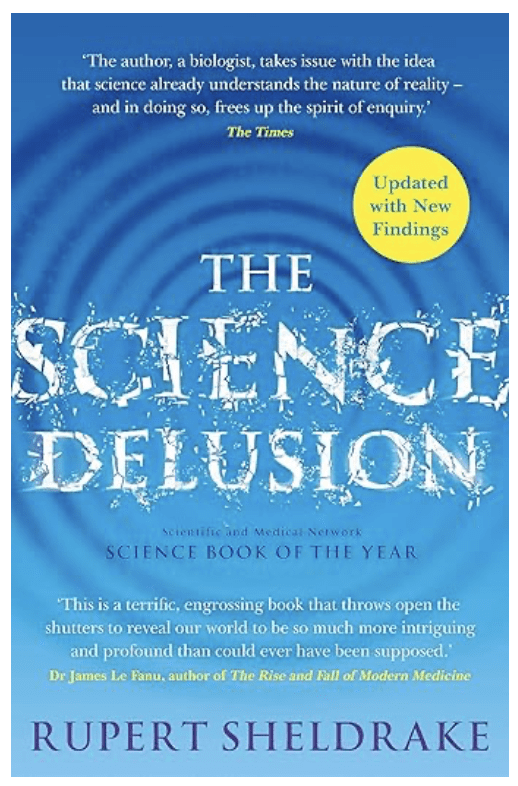
The Science Delusion
Rupert Sheldrake’s The Science Delusion (also published as Science Set Free) argues that modern science is constrained by a set of unexamined assumptions about materialism, mind, and nature. He suggests that these “dogmas” limit scientific inquiry and prevent exploration of phenomena such as consciousness, memory, and potential nonlocal connections in biology. Instead, he proposes that nature is more dynamic and interconnected than standard mechanistic models allow, and that science would benefit from relaxing its current philosophical boundaries.
Key ideas include:
- The mind may not be fully confined to the brain (“extended mind”)
- Biological systems may be influenced by nonlocal organizing principles (“morphic resonance”)
- Memory and learning may involve fields beyond neural storage alone
- Some anomalous phenomena (e.g., telepathy-like effects or sensing being stared at) may warrant scientific investigation
- Scientific materialism may be too restrictive as a framework for understanding consciousness and life
The book is influential in consciousness studies and alternative science discussions but remains controversial in mainstream biology and neuroscience due to limited reproducible evidence for its central hypotheses.
Our company may earn a small commission for the sale of these products. We participate in the Amazon Services LLC Associates Program, an affiliate advertising program designed to provide a means for sites to earn advertising fees by advertising and linking to Amazon. This website, its free reports, content and any linked material are presented for informational purposes only and are not a substitute for medical advice, diagnosis, treatment, or prescribing.”