

07. Standing Wall Supported Head Moving on Eyes Visual Tracking
When you experience stress or tension, your brain and nervous system encode it as a multi-sensory pattern. This pattern can include the felt sense of your body (somatosensation), along with visual, auditory and sometimes even taste and smell associations. Because these patterns are stored through multiple sensory channels, creating new patterns of ease, comfort and freedom in the body and nervous system is often most effective when using multi-sensory techniques.
Humans are highly visual beings, and a significant portion of your brain’s wiring is involved in processing and integrating visual information.
This technique integrates visual tracking patterns (based on principles from Cognomovement) with a foundational postural and breathing retraining technique inspired by the Postural Restoration Institute (PRI). For a deeper and more powerful experience, you may also integrate frequency listening or vocal toning practices while performing.
Only proceed with this technique unless you have mastered Supine Hooklying Head Moving on Eyes Visual Tracking and Standing Wall Supported Visual Tracking
Caution: If you have hypermobility, EDS and/or cervicocranial instability it is advised to not proceed with this technique unless under the supervision of a healthcare provider familiar with your condition.
Equipment Needed
- ~ 4” diameter ball, toilet paper roll or rolled up towel
While performing the following visual tracking patterns, either by themselves or in combination with a postural technique, make sure you continue to breathe as described below. Consider toning on your exhale for an even more enhanced effect.
-
- Inhale gently through your nose
- Pucker or purse your lips as you fully exhale all the air out of your lungs sensing your front lower ribs drop downwards into your belly and your abdominal wall draw in and engage.
- Pause ~3 seconds after each exhale.
- For even more therapeutic effect perform frequency listening or vocal toning practices.
1. Diaphragmatic Breathing and Pelvic Reset
- Stand with the back of your heels ~4-8” away from a wall
- Lean against the wall where the pressure is mostly on your sacrum/pelvis
- Move your right foot forward ~2” ahead of your left
- Place the ball/roll between your knees with your knees slightly bent/unlocked.
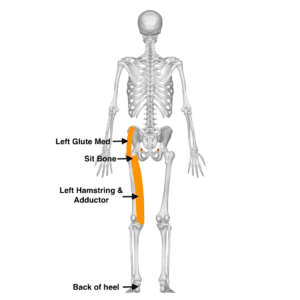
- Imagine a magnetic attraction between your sit bones and the back of your heels as you perform a pelvic tilt by bringing your tailbone away from the wall and rounding out your low back. This will bring your low back in more contact with the wall. You should feel your hamstrings (back of your thighs) engage.
- Optional Advanced:
- Next, shift your right knee forward and your left knee backwards. This will bring the right side of your pelvis off the wall and place about 80% of your weight on your left leg with engagement of your left hamstring, inner thigh and outer hip/pelvis.
- Optional Advanced:
- Maintaining this position, inhale slowly and softly through your nose with a relaxed neck.
- Exhale all the air out of your lungs fully through pursed lips, allowing your front ribs to drop and sense your abdominals to engage.
- Pause after each exhale until a mild urge to breathe returns, then repeat for a total of 5 breath cycles.
2. Head Moving on Eyes Visual Tracking
Caution: If you have hypermobility, EDS and/or cervicocranial instability it is advised to not proceed with this technique unless under the supervision of a healthcare provider familiar with your condition.
- Maintain your pelvic tilt with optional hip shift.
- Hold the ball in front of your chest with both hands.
- Keep your eyes fixed on the ball while moving your head in an alternating hemi-circle pattern, beginning by moving downward through the midline, then out to the side, upward and back across center before switching to the opposite side.
- Perform this movement for one full breath cycle.
- Raise the ball 1–2 inches higher and repeat the alternating hemi-circle head movement (moving downward through the center) for another breath cycle.
- Continue moving the ball upward in 1–2 inch increments along the midline, completing one breath cycle at each position.
- Move only as high as you can while keeping the ball in view without tilting your head upward.
Next:
- Choose a direction (right or left).
- Move the ball 1–2 inches to that side using the same-side hand.
- Keep your gaze fixed on the ball while continuing the alternating hemi-circle head movement pattern.
- After each breath cycle, move the ball a few inches farther outward.
- Continue until you have completed an entire hemi-circle pattern.
This is the pattern your head will move:

This is the pattern you will incrementally fix your eyes:

Move at a pace and range where you can:
- Maintain visual fixation on the ball
- Move your head comfortably
- Avoid neck strain. Discontinue if you experience discomfort and focus on the preceding techniques.
Dosage: Perform 1–3 rounds, 1–3x daily unless otherwise directed.
Goals:
-
- Keep the neck relaxed
- Maintain pelvic tilt with hamstring engagement and optional hip shift with inner thigh engagement
- Perform the movement without eye or neck strain
- Maintain smooth visual fixation and neck motion throughout the infinity pattern
- If performing toning, stay in tune with each frequency.

- If you have any questions or need help with this exercise, join our Weekly Healing Q&A here.
- Join us for full access to the Resonate Health Master Guide
Enjoy these other related Master Guide items to resonate health:
Disclaimer and Copyright
This physical exercise recommendation is being provided for informational purposes only and is not a substitute for medical advice.
Please consult your medical doctor or professional if you have medical concerns. If you experience any discomfort or pain, discontinue the exercise.
Technique inspired by Cognomovement and the Standing Wall Supported techniques by the Postural Restoration Institute®. www.posturalrestoration.com
©️ 2026 Resonate Health. This video may not be duplicated, copied or shared unless authorized.


CONTACT US
PRIVACY POLICY
TERMS OF SERVICE
CONDITIONS AND CONSIDERATIONS INFORMATION
© Resonate Health 2026 Original design by Abracadabra Creative | Ongoing development by Christian McFarland