


02. Standing Single Push with Single Leg Grounding
This PRI inspired technique helps to get you to appropriately ground on one side of your body while rotating in the opposite direction in your rib cage, mimicking what should naturally happen during walking and running.
Reinforcing these neuromuscular patterns not only optimizes your movement mechanics but also helps to stabilize and maintain alignment throughout your entire postural system during all positions and activities.
Due to the inherent asymmetry of the human body, you are going to bias grounding the left leg while rotating your rib cage to the right. Notice your increased sense of groundedness and mobility as you move afterwards.
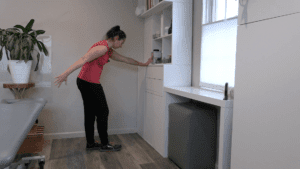
Equipment Needed:
- Countertop or sturdy table/desk.
Instructions:
- Standing with your feet about 1-2 inches apart and 2 of your foot lengths (~ 18 inches) away from the edge of the countertop/table/desk, place your hands on the edge of the surface.
- Push your hands into the edge of the surface (do not direct your force down towards the ground but as if you are elongating your arms away from your body). This will round out your back. You will maintain this push throughout the technique.
- You should feel weight primarily going through your heels while keeping your feet fully planted on the ground. Your hips will be a little behind your knees and ankles.
- Notice the back of your thighs (hamstrings) are activated while the front of your thighs (quads) are relaxed. If your quads are primarily working you likely need to round out your back and/or shift your weight back more.
- Softly, slowly and fully inhale through your nose keeping your neck and shoulders relaxed as you maintain a push/elongation with your arms into the edge of the surface. Sense the area between your shoulder blades expand.
- Purse or pucker your lips as you slowly and fully exhale all of the air out of your lungs sensing your abdominals draw in and engage.
- While keeping your left knee unlocked, slide your right foot forward about 6 inches so that the majority of your weight is now on your left leg while keeping your left hip shifted back behind your knee. You are now sensing your left hamstring primarily working. The right hamstring should be relaxed.
- Reach backwards with your right arm keeping your thumb pointed down. Elongate your right arm in this direction as you sense the area between your spine and right shoulder blade engage.
- While maintaining this position, continue to inhale softly, slowly and fully through your nose during inhalation, noticing the area between your spine and shoulder blade expand on the side of the pushing arm.
- Purse or pucker your lips and slowly and fully exhale all of the air out of your lungs sensing your abdominals draw in and engage.
- Pause until you feel a mild urge to breathe again.
- Perform 5 breath cycles.
- Switch to the other side so that you are grounding through your right leg and reaching backwards with your left arm. Perform 5 breath cycles.
- Return to grounding on the left leg and reaching backwards with the right arm for another 5 breath cycles.
- Complete 2-3 sets of 5 breath cycles, on each leg, but always start and finish grounding on the left leg while reaching back with the right arm. (ie. 2 sets on the left/1 set on the right, or 3 sets on the left/2 sets on the right.)
Perform 2-3x/day, for the next 3-4 days. *Unless otherwise directed
-
- Optionally, use your testing technique to determine your optimal frequency and duration to perform.
Support the Master Guide
If this Master Guide has supported you, please consider making a donation to help keep this free resource available.