


02. Seated Alternating Reaches

This is a go to PRI based technique to optimize your breathing, lung health and posture!

It does a wonderful job of reducing neck tension which is often caused by restrictions in the rib cage and diaphragm muscle. Notice the increased fluidity and breath you have after performing.

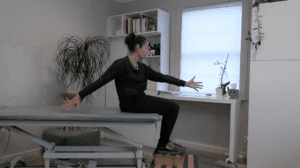
Left arm back, Right arm forward = Left rib cage rotation
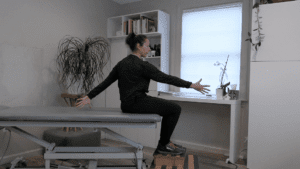
Right arm back, Left arm forward = Right rib cage rotation
Equipment Needed:

  • Chair with no arm rests or support with no back.
  • Support for under your feet so your knees are at least the same height as your hips.

Instructions:

  1. Sit on a chair with a book/block under your feet so that your knees are at or above your hips.
  2. Roll your pelvis back so you sense your sit bones on the chair surface.
  3. Reach forward about 30-45 degrees with your R arm (thumb up) and backwards about 30 degrees with your L arm (thumb down). Make sure you are not flexing your wrist joints and are keeping them straight.
  4. Softly, slowly and fully inhale through your nose and elongate your back arm sensing the muscle besides your shoulder blade (lower trap) engage. This will rotate your rib cage to the left. Notice your front left chest wall opening.
  5. Purse your lips and softly, slowly and fully exhale as you elongate your front right arm. This will help engage your abdominals as you sense your rib cage twisting left. Do not allow your body to lean forward while doing this. Your chest should stay centered over your pelvis.
  6. Pause after your exhale until you feel a mild urge to breathe. Repeat 2 more times for a total of 3 cycles.
  7. Switch arms. You will now elongate your backwards right arm as your inhale and your front left arm as you exhale. Notice your rib cage twisting to the right with each breath. Feel your front right chest wall expand on inhale while your right lower trap activates. During exhale feel your abdominals engage.
  8. Complete 3 cycles total, 2-3 times each side.
  9. Perform 2-3x/day, for the next 3 days. *Unless otherwise directed.
    • Optionally, use your testing technique to determine your optimal frequency and duration to perform.


Goal: While keeping your neck and shoulders relaxed:

    • During inhalation, on the side you are reaching backwards with, sense your front chest wall expand as the muscle beside your shoulder blade (lower trap) activates.
    • During exhalation, sense your abdominals engage.
    • Feel your rib cage rotate with each elongated reach.