


04. Supine 90/120 Hip Shift
This PRI based grounding technique focuses on restoring appropriate shifting relationships between your hips and pelvis, an essential element to optimizing your postural alignment, movement and even your breathing! Notice how much more movement you have in your hips and pelvis walking afterwards!
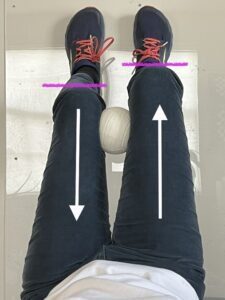
Equipment Needed:
- ~ 4" diameter ball, toilet paper roll or bunched up towel.
- Towel roll to support the curvature of your neck.
- Any additional toweling or pillows to support your neck and head.
Instructions:
- Lie on your back with your feet flat up on the wall with your hips directly below your knees and your feet above your knees. Your knees will be at about a 120° angle.
- Place a towel roll under your neck to support its curvature. Your head and neck should feel comfortable. If you sense discomfort add additional support using the least amount of toweling to feel comfortable.
- Place the ball/toilet paper roll/bunched up towel between your knees and hold it in place.
- Perform a pelvic tilt by lifting your tailbone towards the ceiling while still keeping contact with your low back on the ground. Notice your knees rising to the ceiling. You should sense the back of your thighs (hamstrings) engage.
- With your hands, feel the front of your thighs (quads) to make sure they are relaxed. If they are tight/activated you are likely pushing into the wall. Retry so that you are only using the back of your thighs/hamstrings to perform the pelvic tilt.
- Shift your left knee/thigh down and your right knee/thigh up while keeping your thighs perpendicular to the ground. You should sense your left inner back thigh engage while the right relaxes.
- Holding this position, lift your right foot off the wall so that your left leg is grounding you. You should sense even more activation of your left hamstring and inner thigh muscles.
- If it is too challenging to lift your foot off the wall or you lose your pelvic position, keep your foot on the wall while performing.
- While maintaining this position, inhale softly, slowly and fully through your nose, keeping your neck relaxed. Then purse your lips to fully exhale all the air out of your lungs. Pause until you feel a mild urge to breathe again and repeat.
- Notice during inhalation the area between your shoulder blades expanding into the ground as well as the upper chest.
- Notice during the pursed lip exhalation your abdominal muscles draw in as your front lower ribs fold into your belly.
- Keep your neck relaxed throughout the breath cycle. You may place your hand on the front of your neck to give you feedback about whether your neck is staying relaxed or not.
- Perform 5 breath cycles, return to neutral.
- Perform another pelvic tilt and then shift your right knee/thigh down and your left knee/thigh up while keeping your thighs perpendicular to the ground. You should sense the right inner back thigh engage while the left relaxes.
- Holding this position, lift your left foot off the wall so that your right leg is grounding you. You should sense even more activation of your right hamstring and inner thigh muscles.
- While maintaining this position, inhale softly, slowly and fully through your nose, keeping your neck relaxed. Then purse your lips to fully exhale all the air out of your lungs. Pause until you feel a mild urge to breathe again and repeat.
- Perform 5 breath cycles, return to neutral and then repeat 5 more breath cycles shifting the left knee down/right knee up keeping the left leg on the wall/right leg in the air.
- You may perform 1-2 more cycles of left, right, left leg on wall. Always start and finish with the left leg on the wall/right leg up.
Perform 2-3x/day, for the next 3-4 days. *Unless otherwise directed.
-
- Optionally, use your testing technique to determine your optimal frequency and duration to perform.
Support the Master Guide
If this Master Guide has supported you, please consider making a donation to help keep this free resource available.