09. Alternate Nasal Breathing

Alternate nasal breathing is an excellent technique to help you not only open up your sinuses but facilitate your body’s natural left and right alternating rhythms in your lungs, nervous system and brain. 

Did you know that we naturally alternate breathing primarily through each nostril about every 3-4 hours but it can range from anywhere between 2-8 hours? One nostril is generally more open and the other more closed at any given time. 

However, in cases where you may have congestion, a deviated septum, enlarged turbinates, polyps, narrow nose/dental arch and/or breathing dysfunction this natural alternating rhythm may be impaired. Furthermore, due to the body’s natural pattern of asymmetry, the left nostril is typically more narrow and restricted than the right. 

Nasal tissue is highly innervated by the sympathetic nervous system where increased activity is associated with increased vasoconstriction and less congestion. 

  • Nasal shifting is coupled to lung inflation. 
    • Forced inhalation through one nostril is paired with increased lung inflation on the same side (referred to as the pulmonary reflex mechanism). 
  • The nasal cycle is paired with contralateral hemispheric function. 
    • Increased performance of verbal (L hemisphere dominant) tasks is associated with R nasal breathing 
    • Better spatial (R hemisphere dominant) task ability is associated with the left nasal cycle. 
  • The nasal cycle correlates sleep stages. with REM and NREM sleep stages where the 
    • Right nostril dominates with REM (rapid eye movement) sleep stage.
    • Left with NREM (non-rapid eye movement) sleep stages.
    • Insomnia has shown to be associated with unilateral nasal obstruction. 

Our bodies and brains are designed to naturally shift and oscillate side to side. This includes the nasal cycle which has significant breathing, sleep and brain function. To learn more about our inherent bodily rhythms you may refer to this article.

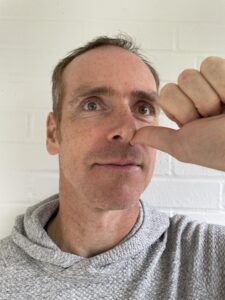
Right Nasal Occlusion

Left Nasal Occlusion

Equipment needed: 

  • Chair with a book/block under your feet so that your knees are at least at the same level or above your hips.
  • Optional to perform in kneeling. May need towels or pillows for support. 

Instructions:

  1. Sit on a chair with a book/block under your feet so that your knees are at least at the same level or above your hips.
  2. Round out your low back so that you roll back onto your sit bones. You will be slouching a little.  Do not arch your back or stick your chest out in front of you.
  3. Cover your right nostril with the pad of your thumb. Do not squish your nose. Only use enough pressure to block the airflow.
  4. Inhale softly, slowly and fully through your left nostril keeping your neck and shoulders relaxed
  5. Switch your thumb to occlude your left nostril and exhale softly, slowly and completely out of your right nostril. Pause until you feel a mild urge to breathe again. 
  6. Inhale softly, slowly and fully through your right nostril keeping your neck and shoulders relaxed. 
  7. Switch your thumb to occlude your right nostril and exhale softly, slowly and completely out of your left nostril. Pause until you feel a mild urge to breathe again. 
  8. Inhale softly, slowly and fully through your left nostril keeping your neck and shoulders relaxed. 
  9. Switch your thumb to occlude your left nostril and exhale softly, slowly and completely out of your right nostril. Pause until you feel a mild urge to breathe again.  
  10. Continue this alternating rhythm so that you perform 8 cycles on each side, starting and finishing with the left nostril open. Switch the nostril you are blocking after every inhale. 

Perform 3-4x/day and as needed at any time. *Unless otherwise directed

  • Optionally, use your testing technique to determine your optimal frequency and duration to perform.


Goals: While keeping your neck and shoulders relaxed:

  • Breathe with air flowing easily through each nostril.

The ability to breathe primarily through your nose is very important to your health.  If you have significant restrictions in your ability to breathe through your nose a one-on-one consultation is recommended to help guide you in the right direction to restore this essential human function.